
Vacuum pouches for meat are chosen in a different order from most flexible packaging. The product is wet, it often carries bone or a trimmed edge, and it spends its life chilled or frozen, so the pouch has to survive evacuation, seal across a wet surface, and hold its barrier once the pack is cold and being handled. Gauges alone are a poor guide. What decides the outcome is the barrier layer, the seal layer, the fit with the vacuum machine, and how the pack behaves after the first carton is stacked. This guide works through those decisions in the order that avoids rework.
Key Takeaways
- Bone, shells and frozen folds drive the film structure more than total gauge does.
- Vacuum already removes most free oxygen, so a higher barrier brings smaller gains than the numbers suggest.
- Seal performance has to be judged at the temperature and dwell the machine can actually hold.
- Only the finished pack, tested cold and under load, gives a result worth acting on.
How Vacuum Pouches for Meat Differ From Dry-Food Pouches
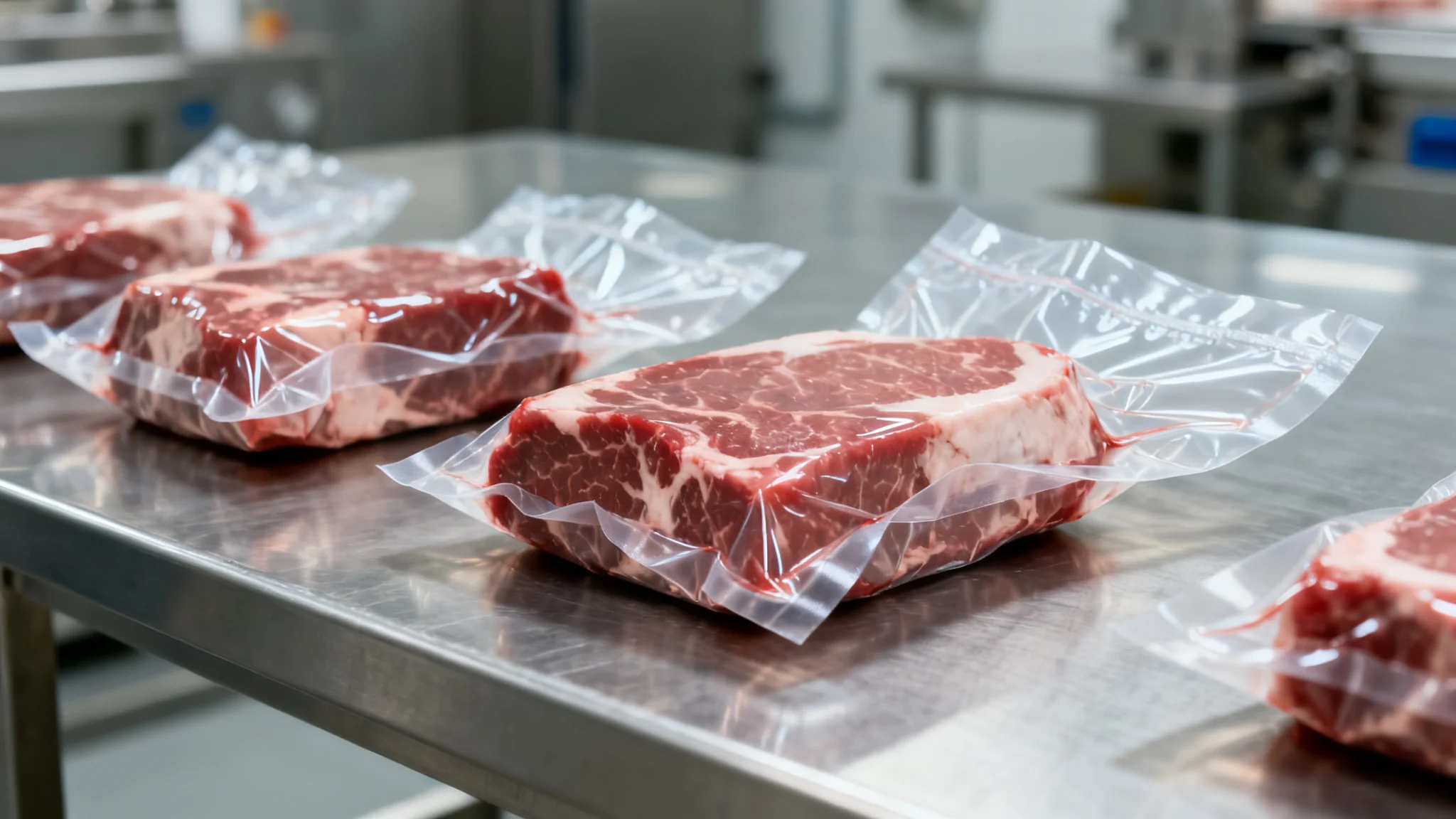
A dry snack pouch is filled with air still inside it, and the seal closes over a clean, low-fat surface. A meat pouch is evacuated, which means the film is pulled tight against the product and any sharp edge presses into it from the inside. The seals close over an area that has just been in contact with a wet surface. The finished pack is then chilled or frozen, which changes how the film behaves, and it goes into a carton where it is stacked.
Those conditions push the design in several directions at once. Puncture resistance matters more than stiffness. Seal integrity across a possibly contaminated area matters more than seal appearance. Low-temperature toughness matters more than high-temperature performance, unless the product is also cooked in the pack. Where the meat is a sliced deli product with a regular shape, the requirements relax and a plainer structure can be enough. The formats used for this product group are collected under custom meat packaging.
What Sets the Barrier Requirement?
Start with what the meat is protecting against, then decide how much barrier is really needed. Vacuum removes most of the free oxygen, so the demand on oxygen barrier is lower than for a flushed dry product, and the primary risks become moisture loss, drip leakage and, for longer chilled distribution, oxidative change in the fat. Frozen meat sits at low temperature where most reactions slow down, so the barrier requirement is usually more modest than buyers expect.
Oxygen transmission figures are only comparable if they were produced under the same test conditions, which is why the method is normally named alongside the value; the ASTM D3985 oxygen transmission method is the usual reference for film structures. Where the pack also has to resist puncture from bone, the film has to carry a tougher inner layer, and that decision is separate from the barrier decision. Judging both with one number is the most common mistake in a specification review.
Thickness, Structure, and the Bone Problem
Buyers often start from a micron figure because it is the easiest thing to quote. Structure is the more useful starting point. A coextruded film with a tough inner layer behaves differently from a laminated film of the same total gauge, and the two are not interchangeable on a line that handles bone-in cuts. Where the product has bone, the inner surface is the layer doing the work, and increasing total thickness without changing that layer buys less than expected. Standard meat vacuum bags are usually specified from the cut and the machine rather than from a micron target.
Where the meat is boneless and neatly trimmed, a straightforward structure is usually adequate and easier to run. Where the pack is filled and then frozen, the film has to stay flexible at low temperature; a structure that becomes brittle in a freezer will crack at a fold long before it fails in a tensile test. This applies to chilled and frozen distribution as well as to packs that are shipped unfrozen and frozen later.
Which Vacuum Machine Are You Buying For?
Chamber machines, nozzle machines and thermoforming lines place different demands on the film. A chamber machine pulls a deep vacuum in a rigid chamber and the pouch must not collapse so far that seals crease. A nozzle machine draws air through the pouch mouth, so the film has to stay open enough for the nozzle without losing shape. A thermoforming line forms the bottom web into a cavity, which is a different product category entirely.
Two properties drive most of the machine fit. The first is how fast and how fully the pouch evacuates, which depends on how the film behaves as it is pulled. The second is seal performance at the temperature and dwell the machine can actually hold, not the optimum printed on a datasheet. The practical check is a short run on the actual machine, which is why the machine model belongs in the first enquiry rather than in the final order.
What to Confirm Before a Sample Is Made
- Cut type, and any bone, shell or trimmed edge that will touch the film.
- Fresh, chilled or frozen distribution, and the lowest temperature the pack will see.
- Cooking or reheating in the pack, if the product is prepared that way.
- Vacuum machine type, chamber or nozzle, and the seal bar width.
- Target seal temperature and dwell time the machine can hold.
- Pack dimensions and fill weight, with the headspace left free for the seal.
- Stacking, hanging or tray display once the pack reaches the cabinet.
Seal quality is the item most often taken on trust. Testing the finished pack rather than the flat film is the only way to see how a contaminated or folded seal behaves, and the comparison of seal integrity testing methods explains which technique answers which question. Seal strength itself is usually reported using the ASTM F88/F88M seal strength method, so that figures from different suppliers can be placed side by side.
Conclusion
Work in the order of product risk first, machine second, structure third. Decide what the meat is exposed to, confirm which vacuum machine and which temperature range the pack will actually run through, then pick the barrier and inner layers. A micron figure on its own settles nothing, and oxygen or moisture values only mean something when the test method travels with them. Where bone or a frozen fold is involved, the finished pack has to be tested cold and under load, because a flat-film result will not predict it. Sample quantities and trial lengths are best agreed against the machine that will run the job, and flexible packaging services describes how a trial is normally staged.
Frequently Asked Questions
Do bone-in cuts need a completely different film from boneless meat?
Usually yes, at least in the layers that touch the product. Bone concentrates a puncture load from inside the pack, so the inner layer has to be a tough one rather than a plain sealing layer. Boneless, well-trimmed cuts rarely need that. Tell the supplier about bone, shell or trimmed edges before a structure is proposed, because with vacuum pouches for meat the change sits in the layers, not in the gauge.
Can one vacuum pouch run on both a chamber machine and a nozzle machine?
Often not without compromise. A chamber machine pulls the whole pouch into a deep vacuum, while a nozzle machine draws air through the pouch mouth, and each places the film under different stress as it evacuates. A structure that evacuates cleanly on one can crease or lose shape on the other. Test both machines if both will be used, rather than approving a film on one and assuming the result carries over.
How should a frozen meat pouch be evaluated before approval?
Test it frozen rather than at room temperature, and test the finished pack rather than flat film. Freeze the filled pack, then check the seal and the film at the folds the carton will actually create, because a structure that is flexible when warm can crack when cold. Impact and stacking behaviour should be checked in the same cold state, using the load and the number of packs per carton that production will really use. Most failures in vacuum pouches for frozen meat come from conditions a flat sample never sees.
Does a higher oxygen barrier always extend the chilled shelf life?
No. Vacuum packing already removes most free oxygen, so the remaining gain from a higher barrier is smaller than the numbers suggest, and for frozen product it is smaller again. Moisture loss, drip leakage and temperature control during distribution usually matter more. Where a longer chilled shelf life is the goal, set up a storage trial with the real product and compare packs side by side instead of specifying a higher barrier by default.