
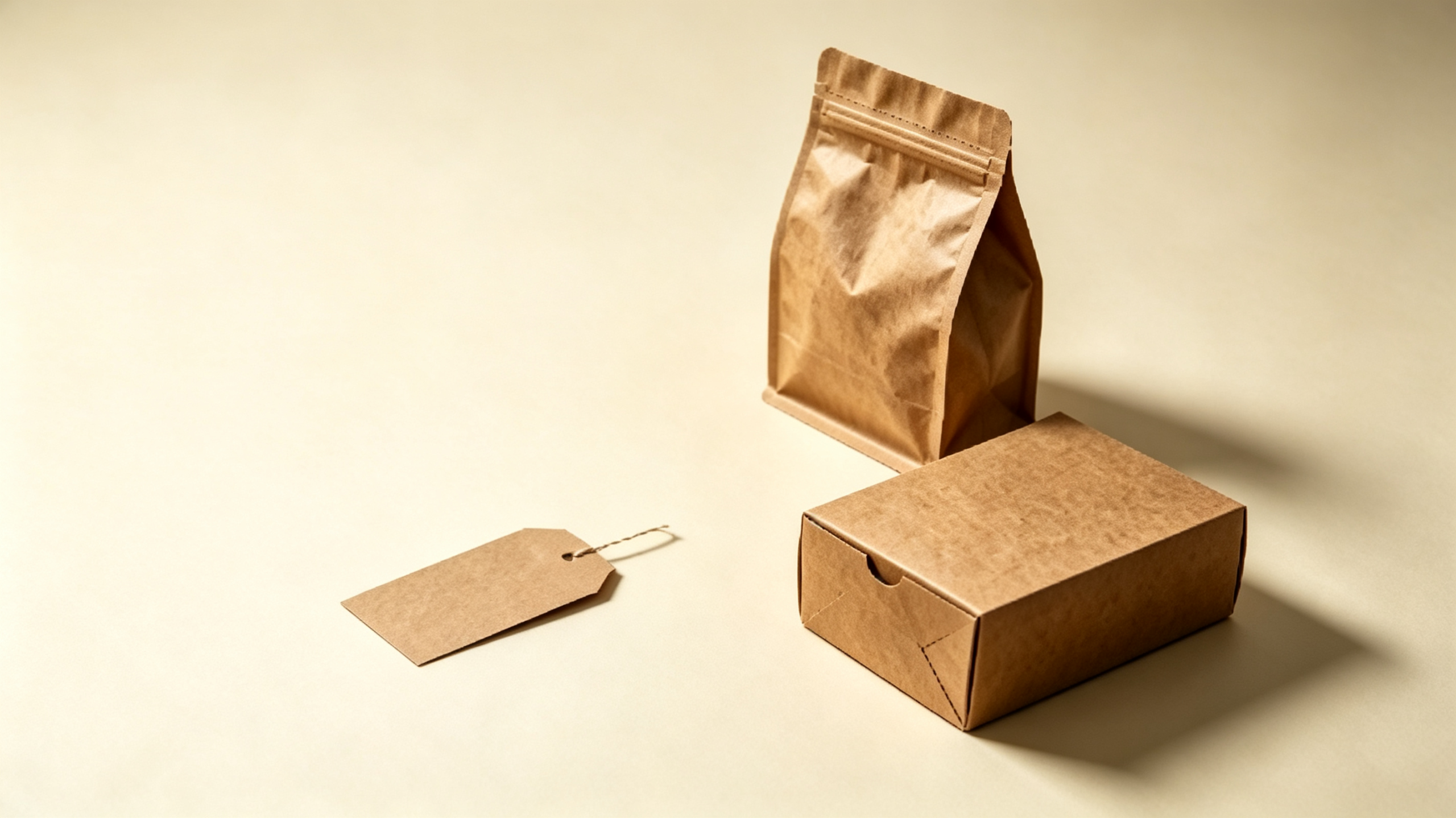
Custom kraft paper pouches for food are never made from a single material. The kraft layer supplies the look and part of the stiffness; the sealant and, where the shelf life demands it, a barrier ply do the protecting. Paper cannot heat-seal to itself in any practical way and offers no meaningful oxygen or moisture barrier, so every kraft pouch is a laminate. Design and packaging options follow from that division of labour.
What does the paper layer actually do?
Kraft paper comes from a chemical pulping process that leaves the cellulose fibres long, which is where the name comes from; kraft denotes strength. In a pouch that strength shows up as stiffness and tear resistance, so the pack keeps its shape on a shelf and survives handling without splitting at the fold. The visible fibre texture and the matte surface are the second job, and for brands selling coffee, tea or nuts they are usually the reason kraft was chosen at all.
What the paper does not do is protect. It is porous, it absorbs water, and it will not seal to itself. Those three limits define everything else in the structure.
Which paper grades are used for food pouches?
Two variables matter: bleaching and paper weight. Unbleached kraft is the warm brown sheet most people picture. Bleaching produces a white sheet that takes colour differently and reads as cleaner and more clinical. Both are used as the outer ply of a food pouch.
Weight is expressed in grams per square metre, and pouch work is commonly specified somewhere between roughly 40 and 120 gsm, with 60 to 80 gsm covering many applications and a heavier sheet used where a large format has to hold its shape. Those figures describe current supplier practice rather than a fixed rule; the grade that suits a given pack has to be agreed with the converter alongside the films described in our comparison of flexible packaging materials.
Which laminate builds protect which foods?
| Build | Foods it is typically specified for | What the liner adds | Design consequence |
|---|---|---|---|
| Kraft / PE | Short-life dry goods, bakery-adjacent snacks | Heat-sealability and basic moisture resistance | Lowest-cost route; the paper face stays visible and printable |
| Kraft / metallised film / PE | Nuts, dried fruit, granola | A moderate barrier against light and oxygen | Keeps a paper face while extending shelf life |
| Kraft / aluminium foil / PE | Coffee, tea, spices | A high barrier against oxygen, moisture and light | Stiffer, less flexible pack; foiling narrows the print scope |
| Kraft / PE with a film window | Products sold on visible quality | Same as kraft/PE, plus a clear panel | Window size and placement become layout decisions |
The table reflects common industry practice. Barrier performance depends on the specific films used, and the pack format chosen alongside the build — stand-up, flat bottom or side gusset — changes how the pack stands and fills. Confirm both against your own shelf-life target rather than assuming from the build name.
Key Takeaways
- Kraft supplies appearance, stiffness and tear resistance; the liner supplies protection.
- Paper weight and bleaching are the two grade decisions that shape both feel and cost.
- The shelf-life target should drive the liner choice, not the other way round.
- Any end-of-life claim has to be checked against the finished laminate, not the paper alone.
Print and design options on kraft
Design that works on white film often disappoints on brown paper, because the absorbent surface and the base colour change how ink reads. Light inks on unbleached kraft come out warmer and duller, so a white base layer is often laid under artwork that needs to lift. Bold line work, solid areas and limited palettes suit the surface; fine gradients and photographic detail generally do not.
Flexographic printing is the standard route for kraft pouches, with digital printing increasingly workable for short runs and versioned designs. Finishing changes the proposition as much as the print does. Matte lamination keeps the natural feel, while gloss varnish or foil stamping adds a premium accent and mutes the rustic character to some degree. A window is the third option and it turns the pack into a partly transparent one, which is worth testing with the product inside, since contents rarely look the way a mock-up suggests.
Where kraft paper pouches work best
Kraft suits products whose barrier needs are moderate and whose brand story leans on natural or craft positioning. This applies to whole-bean coffee, loose-leaf tea, nuts, dried fruit, granola, some spices and certain dry pet treats. Structures that combine a kraft face with a resealable opening appear in the custom kraft pouch range, and the same combination is behind many dried fruit packaging solutions.
The fit is poorer elsewhere. Products needing a very long ambient shelf life push the structure toward heavier barrier plies, and the paper becomes decorative. Frozen and chilled products are difficult because condensation on a cold pack is close to unavoidable. Products that must be visible, or whose design depends on photographic print quality, sit awkwardly on a brown absorbent sheet.
The end-of-life claim needs care as well. A kraft/PE laminate is a multi-material composite and is generally not accepted in paper recycling streams, because the plastic layer contaminates the pulping process, as CEFLEX sets out in its design guidance for a circular economy. Recycled content and certified fibre are separately verifiable claims; recyclability is not a property of kraft as such. Where an end-of-life claim is planned, confirm it against the finished structure and the collection systems in the target market.
Which checks confirm a kraft pouch will hold up?
- Confirm the moisture and oxygen performance of the laminate against the shelf life you intend to claim, using supplier data for the actual build.
- Test the outer face for moisture pickup along the route the product really travels, including any humid leg.
- Check grease resistance where the product carries oil, since a paper face will mark once oil reaches it.
- Check seal quality across the fold where the laminate is thickest, because that is where the paper-to-film bond is worked hardest.
Run these checks on pouches made from your own film and your own product. A kraft pouch that looks right on a bench can still fail in a humid warehouse or inside a mailer.
Conclusion
Treat kraft as the face of a structure rather than the structure itself, and the design options fall into place. Choose the paper grade for the look and the stiffness you want, choose the liner for the shelf life you need, and let the print method follow the surface. Where a long ambient shelf life, a frozen route or a photographic design is the priority, a film pouch with a kraft-look finish will usually serve the product better than a true paper laminate.
Frequently Asked Questions
Can a kraft paper pouch go into paper recycling?
Generally not, for kraft paper pouches in their usual food-packaging form. A kraft pouch is normally laminated to a plastic sealant layer, and that layer contaminates the pulping process, so paper mills and kerbside programmes tend to reject it. Recycled fibre content and certified sourcing are separate claims and can be verified on their own. If recycling matters to the brand, check the finished structure against the collection systems that actually serve your market before making any statement.
Does a heavier kraft grade extend shelf life?
No. Shelf life is set by the barrier films and the seal, not by the paper weight. A thicker kraft sheet gives the pouch more stiffness, helps a large format hold its shape and resists tearing at the fold, but it does not slow moisture or oxygen movement toward the product. Raising the paper weight while leaving the liner unchanged changes how the pack feels, not how long the contents keep.
Can we print photographs on unbleached kraft?
Not with predictable results. The brown base and the absorbent surface shift colours and soften fine detail, so photographic imagery tends to read muddy and unpredictable. Solid areas, bold line work and type hold up well, and a white base layer can lift artwork that needs contrast. Where photographic quality is central to the design, a white-faced or kraft-look film gives a far more controllable result.
What should we test before committing to a kraft laminate?
Send the converter the product and the shelf-life target for the kraft paper pouches first, then test the laminate against both. Confirm barrier performance from the film supplier data for the actual build, check the outer face for moisture pickup along the real distribution route, and check grease resistance if the product carries oil. Add a seal check across the fold, because that region works the paper-to-film bond hardest. Agree results as measured values rather than impressions.